

'Michael' review: Don't stop 'til you feel nothing

Courtesy of Lionsgate
For a film centered on one of the most influential and tightly mythologized figures in pop culture history, it is surprising how restrained and ultimately fleeting “Michael” feels. This is a movie about an artist whose presence once felt unavoidable, yet Antoine Fuqua’s biopic, produced in close proximity with Michael Jackson’s estate, often plays as though it is afraid of its own subject. What emerges is a film offering a sanitized overview of Jackson’s life rather than any genuine attempt to interrogate who he was, what he represented, or why his legacy remains so complicated.
Rather than carving out its own identity, “Michael” drops neatly into the same assembly line mold that has defined so many recent musical biopics. Like “Bohemian Rhapsody,” which shares a producer with this film, along with “Respect” and “Bob Marley: One Love,” it follows a rigid, overly familiar structure that mistakes chronology for storytelling. These films tend to confuse the act of recreating famous moments with the act of understanding them, and “Michael” falls into that same trap almost immediately. The movie glides efficiently from milestone to milestone without ever slowing down long enough to ask why any of it mattered beyond its surface-level significance.
The film’s main dramatic focus centers on Michael’s relationship with his father Joseph, portrayed by Colman Domingo under heavy prosthetics. While Joseph’s abuse and domineering presence were undeniably formative, it is explored in broad, repetitive strokes. The relationship never evolves, never deepens, and never accrues the kind of emotional or psychological weight needed to sustain an entire film. As written, Joseph is not terrifying or particularly complex; he is simply unpleasant, which flattens what should be the film’s central source of tension.
What the movie actively avoids is just as telling as what it includes. After well-publicized reshoots reportedly caused by legal restrictions tied to past assault allegations against Jackson, “Michael” conveniently ends in 1988 during the “Bad” tour, stopping just before the most controversial chapters of his life. These allegations are not explored or even meaningfully acknowledged, a decision that fundamentally undermines the film’s attempts at reclaiming Jackson’s story. You cannot selectively present a legacy and expect the result to feel honest. Avoidance on this scale does not read as neutrality; it’s propaganda.
The result is a collection of moments that rush by without leaving much of an impression. There is little sense of interiority or reflection, and nearly every scene feels designed to check off a box fans are expecting to see rather than build insight. While most musical biopics adhere to clichés and rigid creative parameters, the most effective examples, like “Rocketman” and “Straight Outta Compton,” and even to a lesser degree “Elvis,” succeed because they embrace artistic license and point of view or at least attempt to reframe their subjects.
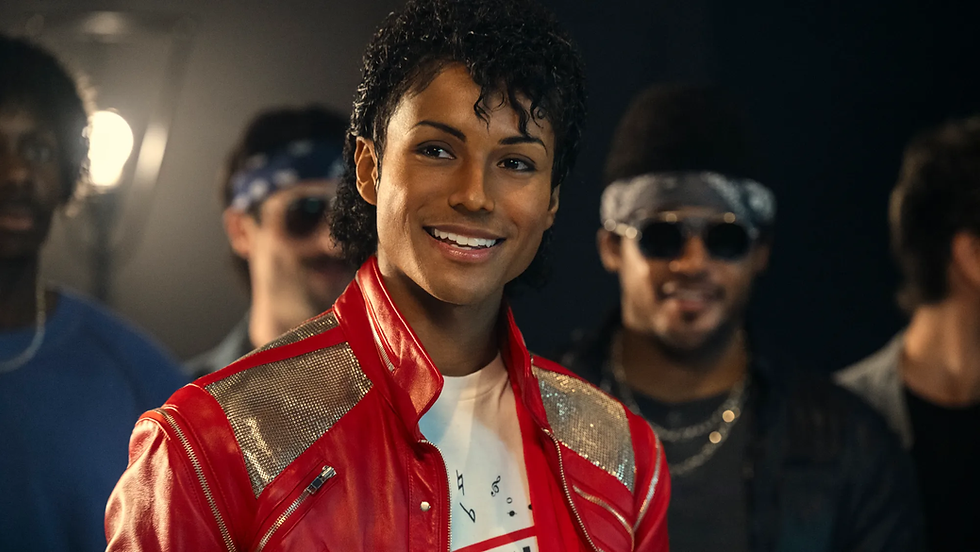
The movie’s strongest asset, by a mile, is Jaafar Jackson, Michael’s real-life nephew, who gives a committed and often impassioned performance. His control over Michael’s vocal patterns, moonwalking physicality, and stage presence goes well beyond simple imitation. There are moments where the illusion is genuinely striking, and his performance suggests an emotional depth the film itself is unwilling to explore. Jaafar does everything he can to anchor the movie, and his work makes it impossible not to wonder how much stronger “Michael” might have been if the screenplay and direction had met him halfway. That sense of frustration is compounded by baffling omissions, including the complete absence of Janet Jackson, whose role in both Michael’s life and the larger Jackson family story is impossible to ignore.
Unsurprisingly, much of the film functions as a parade of greatest hits, though even that comes with diminishing returns. The musical numbers are present, but they are often stitched together mechanically, with little sense of build or release. The film moves so quickly that scenes barely have time to register before the next timestamp appears on screen. So much happens, yet very little feels substantial. It is exhausting without being immersive, and busy without being engaging.
Condensing a life as prolific as Jackson’s into a two-hour runtime was always going to require difficult choices, but the film’s closing promise that “his story continues,” all but confirming a sequel, makes the rushed pacing even harder to justify. Key moments that could have benefited from deeper exploration, such as the cultural impact of the “Thriller” video or MTV’s resistance to playing videos by Black artists, are brushed past in a matter of minutes. The movie is so eager to keep moving that it never allows these moments to resonate.
Structurally, “Michael” begins in Gary, Indiana, in 1960 and rapidly hops through decades of Jackson’s life, relying heavily on title cards. The sheer volume of which becomes disorienting, and it reinforces the feeling that the movie is more concerned with covering ground than telling a story. Writer John Logan’s script often feels constrained, as if it has been filtered through layers of approvals and legal safeguards. That cautiousness extends to the supporting cast as well. Miles Teller appears for about three seconds as John Branca, while KeiLyn Durrel Jones is given more leash as Bill Bray, Jackson’s head of security, yet even these characters feel underutilized.
The film’s attempts at image rehabilitation are similarly rushed and shallow. Jackson’s philanthropy is presented in the most generalized (and honestly, borderline cringe) terms imaginable. One scene shows him reacting to televised violence, and almost immediately the narrative pivots to the creation of the “Beat It” music video with no meaningful connective tissue between the two ideas. The movie signals intention without doing the work, expecting the audience to fill in gaps the script refuses to address. Before any emotional weight can settle, the film has already moved on.
This lack of patience extends to the musical sequences themselves. Songs like “Don’t Stop ’Til You Get Enough” and “Billie Jean” should feel electric, but the staging, cinematography, and editing are so lifeless that even Jackson’s most iconic performances feel oddly muted. Intercuts of audience members fainting are meant to convey spectacle, yet they function more as placeholders than expressions of genuine excitement. The film gestures at scale without ever embracing it.
Even “Bohemian Rhapsody,” as terrible as it was, understood the value of climactic energy with its Live Aid dramatization. “Michael” never finds an equivalent moment of propulsion. It remains consistently subdued, and its central conflict never has the sauce. The father-son dynamic that anchors the movie lacks the intensity required to carry the narrative, gutting the film of a strong emotional spine.
In the end, “Michael” suffers from a near-total absence of dramatic tension, and that absence feels intentional. This is clearly the version of the story the filmmakers wanted to tell, one that avoids discomfort and favors familiarity. Fans of Jackson will likely enjoy seeing select moments recreated, and Jaafar Jackson’s performance is strong enough to warrant recognition. Julian Krue Validi is also effective as the younger Michael, grounding the early sections with sincerity.
Still, as a film, “Michael” feels incomplete and oddly hollow. Its attempt to recenter Jackson as an artist misunderstood by the world rings false when so much of his story remains untouched. Even setting aside personal opinions about the allegations entirely, the film struggles on a purely narrative level. It is a cautious, over-managed biopic that never justifies its own existence.
With a second part on the horizon, optimism is difficult to muster. If this creative team cannot take risks, confront uncomfortable truths, or even acknowledge essential figures like Janet Jackson, it is hard to imagine a follow-up that feels more vital or inventive. In trying so hard to protect the legend, “Michael” forgets to make a compelling movie, and that may be its most lasting misstep.
Grade: C-
MICHAEL is now playing in theaters.


Comments