

'The Long Walk' review: Stephen King's bleak allegory marches into today's divided world

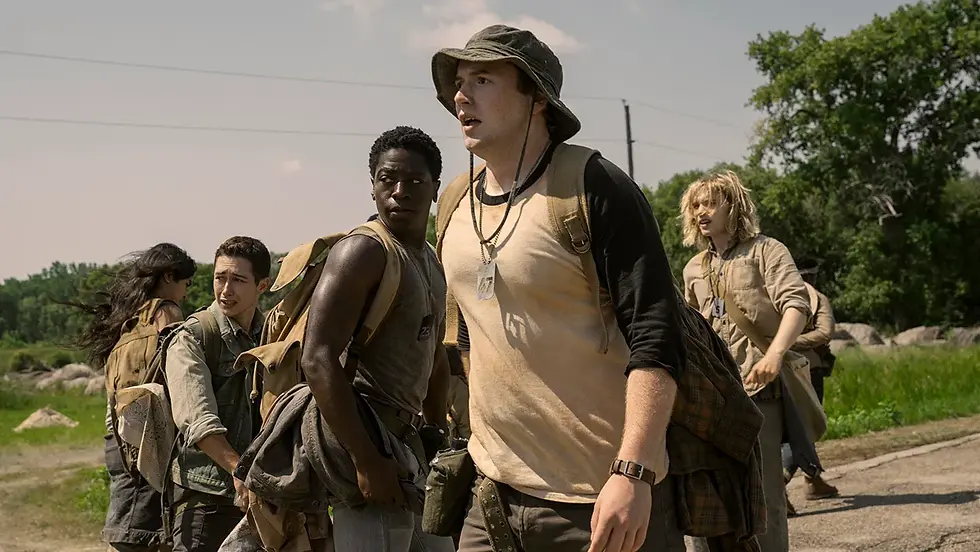
Courtesy of Lionsgate
Stuck in development hell since Stephen King first published the book in 1979 (with Frank Darabont once attached to adapt it), “The Long Walk” has finally made it to the big screen. The director is Francis Lawrence, no stranger to young adults facing grim survival in dystopian landscapes—he helmed several “Hunger Games” films—and he’s a natural fit for King’s harrowing allegory. Released in a moment when political division and public dissent feel sharper than ever, the story lands with startling relevance.
King originally conceived the tale in 1967 as a response to the senseless slaughter of young men drafted into Vietnam. That bleakness remains intact. The premise is chillingly simple: 50 young men (trimmed down from 100 in the novel) are chosen by lottery to walk endlessly until only one remains. Fall below three miles per hour, wander too far from the road, or fail to keep up, and, as the grinning Major (Mark Hamill, clearly enjoying himself) says: “You punch your ticket.” A bullet ends your journey. The sole survivor is rewarded with untold riches and granted anything he desires.
The question of why anyone would volunteer for this ritual drives the tension. Screenwriter JT Mollner gives each walker a backstory, grounding the horror in human motives. Cooper Hoffman’s Ray Garraty isn’t chasing wealth but dreaming of a society that thrives for everyone, not just the privileged few. He quickly becomes the figure we root for, embodying the moral resistance at the heart of King’s work. Like in “Stand By Me,” camaraderie emerges, further proof that King’s stories often shine brightest when built on the fragile bonds between boys under pressure.
Among the many characters, the most affecting is Pete, played with quiet depth by rising star David Jonsson (“Rye Lane,” “Alien: Romulus”). His unlikely friendship with Garraty becomes the emotional anchor of the film. Their shared hopes and sacrifices lend the march both tenderness and tragedy, a reminder that even in the darkest circumstances, connection endures.
At first, the walk has a deceptive lightness, full of chatter and youthful bravado. We meet an eclectic mix—Barkovitch (Charlie Plummer), the stoic Stebbins (Garrett Wareing), the cheeky Olson (Ben Wang)—but Lawrence never lets us forget the grim countdown ticking in the background. Every mile narrows the horizon, every body that falls a reminder of the inevitable. It’s a war movie without the war, where family loyalty, survival instinct, and fleeting dreams all meet the same end.
Book purists may balk at certain changes. The film’s ending, more definitive than the book’s haunting ambiguity, undercuts some of the original’s power. The removal of Garraty’s girlfriend and the scaling back of the voyeuristic television coverage also lessens the social commentary. In King’s version, the spectacle of mass entertainment was as damning as the march itself, and the film misses that sharper edge.
Still, “The Long Walk” emerges as one of the bleakest mainstream films in years. Lawrence keeps the pace surprisingly taut for a story built on repetition, and his cast delivers across the board. Hoffman is compelling, Jonsson continues to prove his reliability as a rising star, and the ensemble is filled with plenty of young talent on the rise.
In today’s age of “Squid Game,” “The Hunger Games,” and the impending “Running Man” remake, “The Long Walk” feels like their stripped-down, somber cousin: less spectacle, more soul. It asks what happens when survival becomes entertainment, when violence becomes normalized, when youth is treated as expendable. Its answers are grim, but its message is timeless: even when the odds guarantee tragedy, the humanity we share along the way still matters.
Grade: B
THE LONG WALK is now playing in theaters.


Comments